
This year’s Leicester Made event at De Montfort University brought together a passionate and knowledgeable array of people from across the fashion industry, all with one common purpose: to revitalise and accelerate the development of UK manufacturing in fashion. It was a really successful and engaging event for organisers Fashion Enter Ltd and the Apparel & Textile Manufacturers Federation.
The panel discussions were a real highlight, covering topics including Innovation & Technology, Costs & Sourcing, Sustainability, Community & Collaboration all within the context of manufacturing locally.
Panellists included many of the most well respected voices from across the industry including Jenny Holloway (FEL), Simon Platts (SP&KO), Snahal Patel (23 Foxes), Kirsty Conner (Never Fully Dressed), Dr Angela Davies (DMU), Elizabeth Brandwood (Style3D), Salli Deighton (LaundRE), Joe Darwen (CircKit), Tamara Cincik (Fashion Rountable), Adam Mansell (UKFT), Joseph Mountain (Nbrown Group), Shaunacy Burne (Salvation Army Trading Company Ltd), Garry Knox (ASBCI & GreenEarth Cleaning), Reshma Desai (The Vayyu Foundation), Tamara Sender Ceron (Mintel), Niall Maplesden (The Knowledge Nexus) and Kevin Withane (Impact Lawyers), Suzanne Ellingham (Source Fashion).
Also present were a wide variety of UK manufacturers, tech providers, accessories businesses and printers. A particular moment of great interest was meeting and discussing potential with Vanessa Barker, Founder of Papillon Bleu, a business pioneering regenerative agriculture, including a Hemp farm right here in the UK, just 15 mins from the venue. Our discussion really demonstrated that so much is possible right here on UK soil, with the right strategic plans in place and the will to drive through innovation and change.
Fascinating discussions were had with various British manufacturers, including T.R.Y. Ltd about the need to embed learning and understanding for our students and junior team members, by visiting and participating in workshops to understand manufacturing processes. With buying teams travelling less overseas, there is a significant knowledge gap developing, which can be rectified if both education institutions and fashion brands/retailers work with British manufacturing to facilitate learning.
On that point, notable by their absence were some of our biggest retailers, such as Next and M&S. For British manufacturing to really flourish, our most successful British businesses need to get behind it and grow their engagement. When I began my career, much of what I was buying was produced in the UK – leggings and t-shirts made at Pasolds in Scotland, dresses and skirts made in at William Bancroft and Clifton Styles in Nottingham and Leicester. As recent as 2019, in my last buying role, I was still purchasing in the UK, but the vast majority of production was offshore, driven primarily by the chase for intake margin, for which the targets continued increase year after year. We need to change the fixation with margin, in order to focus on long term sustainable development and profitability for the survival of the industry. Operational efficiency, investment in technological advance, only producing what is really needed, and buying a higher proportion of product right here in the UK, to facilitate speed to market and drive economic growth should be our key priorities.
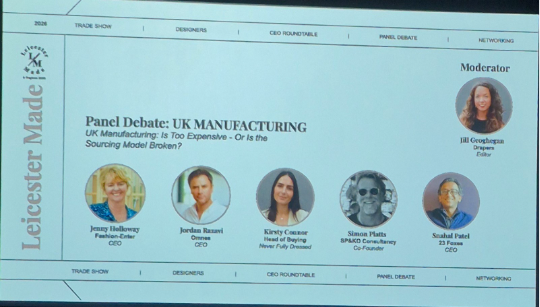
UK Manufacturing – Is it too expensive or is the Sourcing Model broken? Moderator Jill Geoghegan
Panellists argued that an industry obsession with lowest price and intake margin has undermined long‑term profitability and responsibility, with speakers calling for a shift toward net profitability, factoring in returns, markdowns, waste, quality, compliance and producer responsibility.
UK manufacturing was positioned as a strategic asset, offering speed, flexibility and reduced waste, particularly valuable in the context of geopolitical disruption and supply chain volatility.
Brands including Never Fully Dressed and Omnes demonstrated how UK production can succeed when aligned with product strengths, smaller runs and better planning.
Major UK retailers were criticised for failing to invest in domestic manufacturing despite strong local heritage.
Embedding Innovation, Chaired by Kirsty McGregor, Journalist
The discussion focused on the British manufacturing community’s need for collaboration over competition to improve industry representation. Highlighting the importance of local manufacturing over outsourcing, the example of British military uniforms made in China, facilitated by a US defence contractor, was explored. Should government public procurement teams not be supporting UK factories, to ease financial pressures and restore pride in British manufacturing? The UK’s lack of investment in local industries was contrasted with Italy’s 25/26 €250 million to support their fashion industry, in a relaunch of “Made in Italy”, including funds for sustainable development and digital transition. The conversation concluded with a call for unity among UK manufacturing associations to present a unified voice in the endeavour to secure public procurement contracts.
The discussion went on to challenge the misconception that there are no skilled factories in the UK, highlighting the need for recognition of the industry’s capabilities, and emphasising the importance of building real partnerships with British manufacturers. Recognition of the commercial advantages of local production, including job creation, and the need for a re-education on the value of UK manufacturing was also considered.
Whilst discussing innovation and technology in manufacturing, the potential for on-demand production and the use of technology to reduce waste, improve efficiency and enhance competitiveness were key points made by the panel. Opportunities for innovation in materials and product development, including the use of recycled materials were also highlighted as critical.
Transparency and trust were identified as of paramount importance, including the use of accreditations and certifications to help mitigate some of the challenges in finding reliable UK factories. Both will be essential in changing mindsets to build a clear and compelling case for local manufacturing.
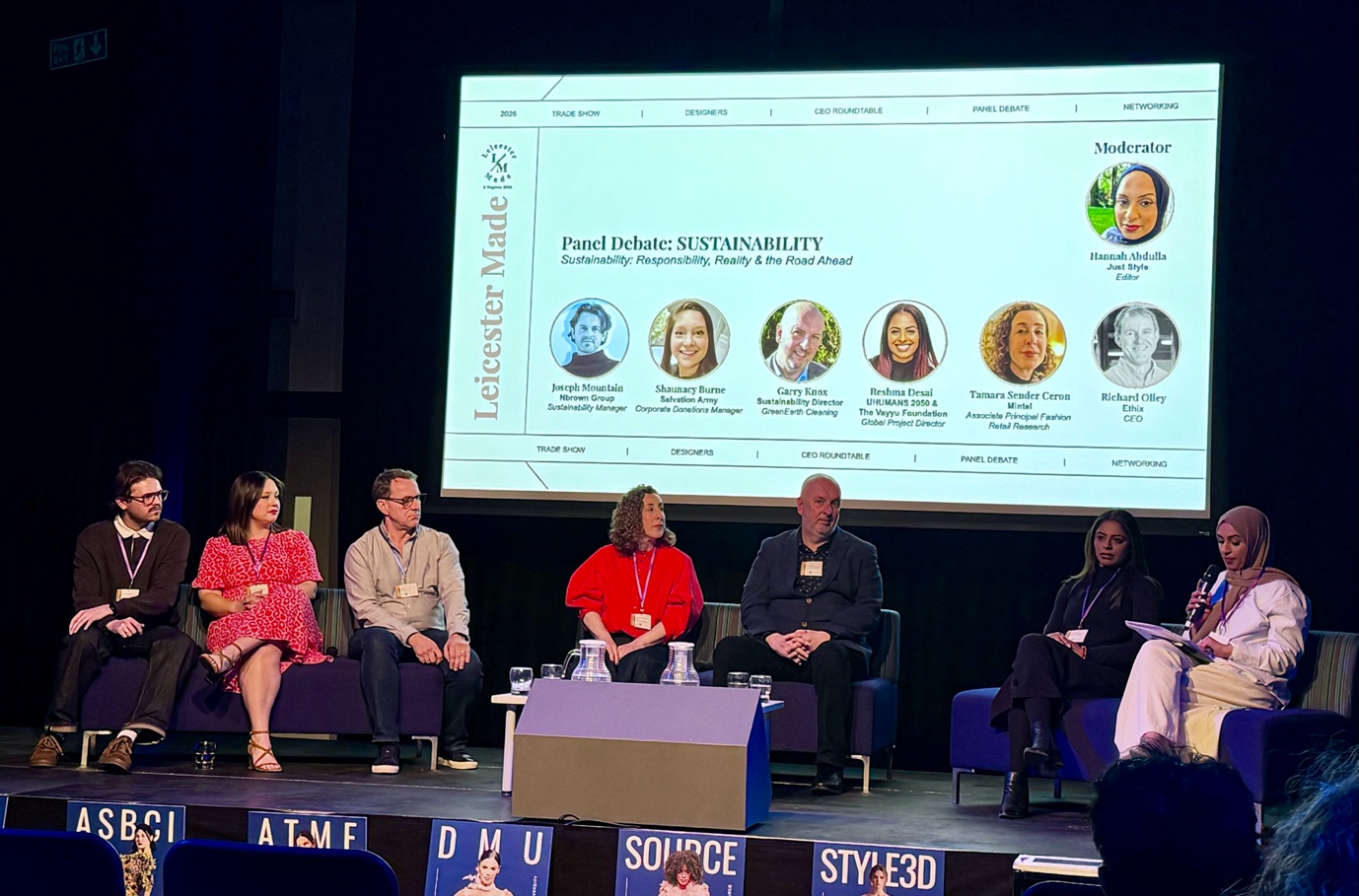
Sustainability & Responsibility for the Future, Moderator Hannah Abdulla, Just-Style
The panel highlighted the urgent need for sustainable practices in the fashion industry, emphasizing significant textile waste of 92 million tonnes globally and 300,000-350,000 tonnes in the UK annually. Key points included the ambiguity of sustainability, the prevalence of greenwashing, and the challenge of consumer trust. The conversation also covered the importance of financial incentives, legislative action, and collaborative efforts among brands, consumers, and policymakers. Specific initiatives like incorporating recycled content and improving care practices were discussed, along with the need for systemic change and education to drive meaningful progress. The panel focused on the need for responsibility and realism in finding action based solutions, rather than blame.
Action Items
• Coordinate stakeholder engagement (brands, manufacturers, charities, policymakers) to create a joined‑up action plan for shared accountability and funding models.
• Explore and pilot subscription/rental models (including non‑toxic cleaning integration) with partners to reduce new purchases and extend garment life.
• Deliver care‑label and customer service training to give consumers consistent care and repair guidance.
• Assess product design changes to improve material inputs, durability and recyclability and produce design guidelines for suppliers and brands.
• Compile policy requirements and timelines to accelerate UK implementation of EPR, green claims regulation and other textile‑focused policies.
• Work with brands to introduce incremental recycled content targets (e.g. 1–3%) and assess end‑of‑life recyclability to avoid unrecyclable blends.
• Map current UK textile recycling capacity and develop a proposal to scale sorting and recycling infrastructure to meet expected EPR volumes.
• Develop and run consumer education materials explaining sustainability claims, durability and care guidance to reduce confusion and combat greenwashing.
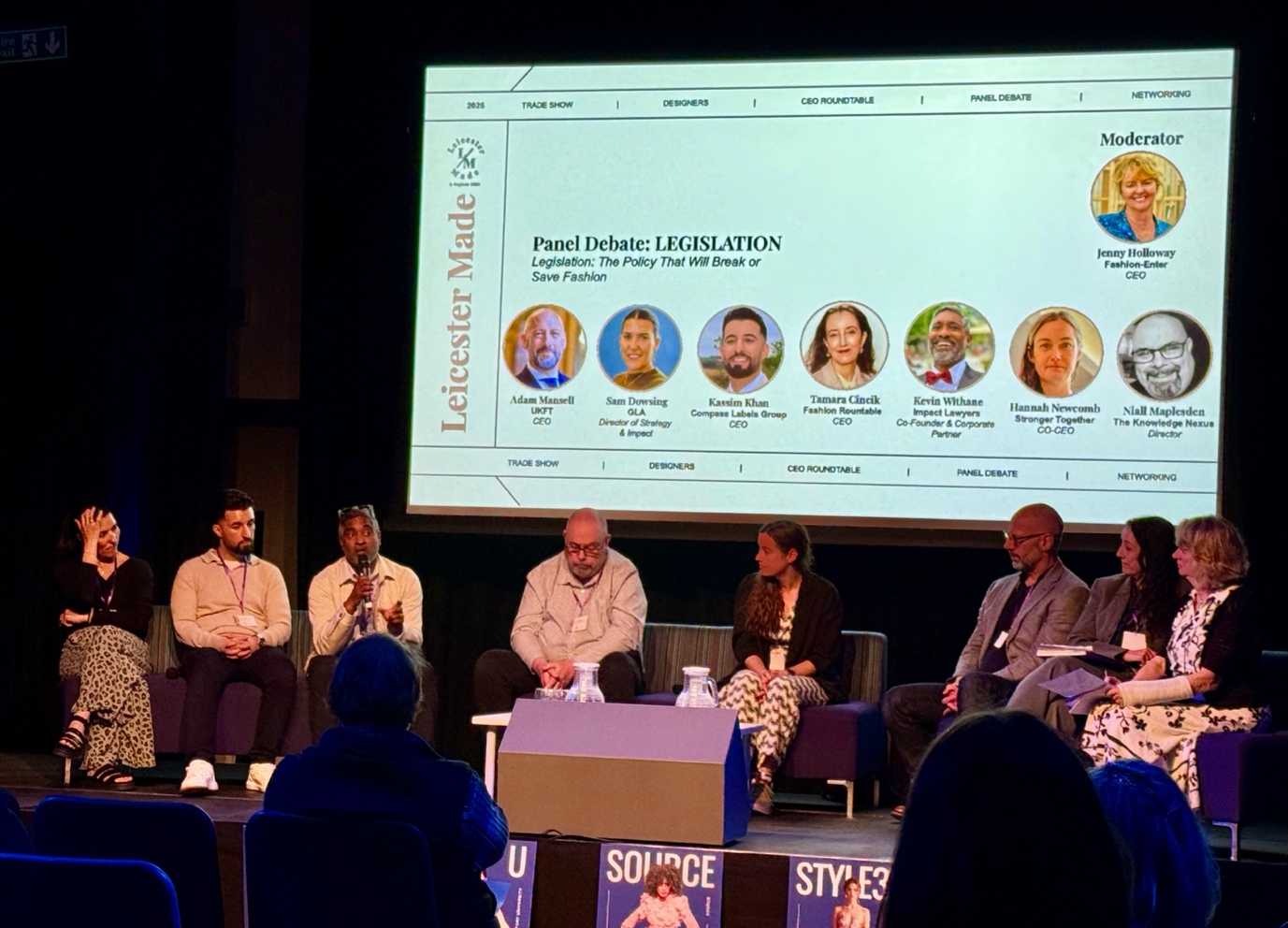
Fashion Legislation Panel, Moderator Jenny Holloway, Fashion Enter
Overview
The panel discussed the impact of Extended Producer Responsibility (EPR) and Digital Product Passport (DPP) legislation on the fashion and textile industry. EPR, already in place in some EU countries, will mandate companies to manage product waste responsibly, with fees reduced for sustainable practices. DPP, expected to be legislated by 2027, will require brands to provide care instructions and durability information. The Employment Rights Act 2025 will introduce significant changes, including day one entitlements and increased minimum wage. The panel emphasized the importance of trade associations, consultants, and proactive measures for SMEs to navigate these regulatory changes effectively.
Action Items
• Follow up with attendees after the session to discuss EPR and DPP implications and next steps for manufacturers.
• Encourage manufacturers to join and actively participate in trade associations and chambers of commerce to access regulatory guidance, influence lobbying and demystify compliance requirements
• Offer support from the Fair Work Agency to reinforce manufacturers’ employment standards and provide guidance on compliance and enforcement powers (engage with industry to identify areas where the agency can add value)
AI in Textiles Innovation
The panel discussed AI’s impact on the textiles industry, with AI tools enabling virtual try-ons, fabric development, and cost-effective design. AI adoption is seen as financially beneficial, with many projects now more affordable at £30-£40k compared to £200-300k of sophisticated PLM systems. Concerns about job displacement were addressed, noting that AI has the potential to enhance productivity and creativity, creating new roles. The importance of collaboration, education, and government support for UK manufacturing was underscored, aiming to position the UK as a global leader in AI-integrated manufacturing. An example highlighted was a successful collaboration between Leicestershire Police and the Textile Engineering and Materials Research Group to develop a safety hijab for active officers.
Action Items
• Collaborate with universities and other industry partners to provide technical expertise during product development and speed up innovation.
• Provide low-cost subscription support and affordable AI/3D tooling options for small businesses, to help them adopt technology, reducing product development and photoshoot costs.
• Engage with government to establish a baseline flow of work and partnership arrangements to support industry growth and enable NHS, Police, Military programmes etc.
• Expand training programmes to educate buyers and designers on factory processes, chemistry, sustainability and implications of decisions made, so they can apply knowledge across the supply chain.
Innovation Challenges in Fashion, Moderator, Kirsty McGregor, Journalist
The discussion focused on challenges in scaling innovation in the fashion industry. Salli highlighted her startup, LaundRE, which uses new technology to refinish unsold stock, raising significant funding and investing £700,000 in machines. She also highlighted the huge challenge faced as a female founder, including gender bias and the struggle to find investors to develop and scale her business.
The panel emphasized the importance of proper pilot planning and integration and discussed the impact of regulations on brand priorities. Success stories included LaundRe’s pilot with River, where refinished stock sold for £20 more than its original price, and Next’s use of 3D technology to drive “right first time” sampling to reduce sample sets from from five to one. One key challenge faced is the importance of organizational buy-in for successful innovation, and the role of compliance and commercial return on investment in driving adoption.
Action Items
• When running technology or manufacturing pilots, define the pilot purpose, required skill sets, business strategy (e.g. sustainability or cost goals), integration plan with legacy systems, and measurable KPIs before starting so results can be quantified at completion.
• Compress product reporting and data-cycle timelines (<90 days) using a mix of automation and AI-assisted workflows to free up team capacity and accelerate decision-making.
• Offer and run small-run production pilots (around 500 pieces or fewer) for brands to test trends, refinish slow stock and validate commercial uplift (e.g. demonstrated price/margin increases) while educating visiting brand teams on the technology.
The day finished with a fireside chat between Jenny Holloway, Simon Platts and Suzanne Ellingham.
In Summary: What This Means for Brands, Manufacturers and Educators
For Brands
Reframe success metrics: Move beyond intake margin as the primary KPI. Long‑term profitability depends on accounting for returns, markdowns, waste, compliance costs and producer responsibility.
Use UK manufacturing strategically: UK production should not be judged solely on unit cost, but on flexibility, speed, lower waste, reduced risk and resilience to disruption.
Prepare now for regulation: EPR and DPPs are not optional. Brands that embed compliance into product design, data management and pricing models early will avoid future cost shocks.
Be radically transparent: Supplier disclosure, ethical positioning and pride in provenance are becoming trust requirements, not marketing add‑ons.
Address overproduction: Reducing volumes, extending product life and improving testing will have a greater sustainability impact than incremental material swaps.
For Manufacturers
Position value, not price: Manufacturers must clearly articulate their contribution to waste reduction, flexibility, speed, skill and ethical compliance, rather than compete solely on cost.
Engage upstream: Greater involvement earlier in design, testing and innovation discussions to strengthen partnerships and reduce risk across the supply chain.
Adopt enabling technologies selectively: Tools such as 3D design and AI should be framed as efficiency, accuracy and communication enablers, not cost burdens.
Collaborate collectively: Unified voices, similar to the Italian manufacturing model, are more likely to unlock public investment, policy influence and industry confidence.
Prepare for visibility: Initiatives such as the “In Factories We Trust” project to raise awareness of reputable UK sources, signal a future where manufacturer practices are publicly visible and reviewed.
For Educators and Institutions
Update curricula urgently: Teaching must move beyond traditional buying models centred on margin and cost, to include net profitability, EPR, DPPs, circularity and ethical risk.
Demystify manufacturing: Graduates entering buying, design and sourcing roles must understand manufacturing realities, production feasibility & the impacts of their decisions, not operate at arm’s length.
Embed systems thinking: Sustainability, innovation and legislation should be taught as interconnected business systems, not standalone topics.
Champion local ecosystems: Educators play a critical role in reconnecting students with UK manufacturing capability, skills and career pathways.
Develop future leadership mindsets: The sector needs leaders trained for long‑term decision‑making, collaboration and accountability, not short‑term optimisation.
Overall, it was an intensely collaborative and informative day, highlighting the need for the British fashion industry to sit up, take notice and invest in UK manufacturing capability. And for the government to follow the EU example in adoption of new legislation and support for local businesses in the pursuit of a more stable economy and job creation. As one audience participant vocalised, the time for talking has been and gone, we are at crisis point, and now is the time for definitive action!
Julia Redman BSc PGCert AFHEA FCMI
Lecturer BSc Fashion Management | Fashion Business School
Zoe Hinton BA (Hons) PGCert FHEA
Senior Lecturer BA Fashion Buying and Merchandising | Fashion Business School


