
Julia Redman, Lecturer, London College of Fashion and Responsible Fashion Consultant
London, June 24, 2025 — The London College of Fashion’s Fashion Business School (FBS) hosted a groundbreaking AI Symposium that brought together industry leaders, innovators, creatives, academics and students to explore the rapidly evolving role of artificial intelligence in fashion. The event was a vibrant crossroads where sustainability, creativity, business strategy, and technology converged – setting the tone for how AI will reshape the industry’s future.
Purpose-driven Innovation: People, Planet, Profit
Opening the day, Dr Liz Gee, Dean of the Fashion Business School, London College of Fashion, UAL, framed the symposium’s purpose within the school’s core mission: advancing knowledge-sharing between students, academics, and industry, while unlocking technological innovation to drive growth for both SMEs and global corporations. The triple bottom line incorporating people, planet, profit, underpinned every conversation, stressing the urgency of sustainable transformation powered by AI.
Genetic AI and the Dawn of Compound Intelligence
A key opening highlight was Dr Satya Banerjee’s presentation on FAIREE hub’s pioneering work in agentic AI – autonomous, adaptable systems designed to act on behalf of individuals or teams. Moving beyond simple automation, this next generation, agentic AI fosters adaptability, autonomy and goal oriented skills to create a symbiotic “compound intelligence”, blending human creativity with machine efficiency to amplify innovation across design, production, and merchandising.
Sustainability: The Industry’s Imperative
Professor Suraksha Gupta shone a spotlight on the fashion sector’s urgent sustainability crisis: with 40% of clothing ending up in landfill, such as the notorious Atacama Desert dump visible from space. The challenge is not lack of research, or understanding of the need for change, but action based translation of sustainable practices into industry reality. AI is emerging as a vital tool to optimise resources, extend garment lifecycles, create circular supply chains and localised solutions that align with the United Nations Sustainable Development Goals.
The day went on to trace the way that AI is shaping every stage of the product design and development process, right the way through to the optimisation of ecommerce and trading strategy, all the while keeping sustainability and environmental impact reduction at the core of its purpose.
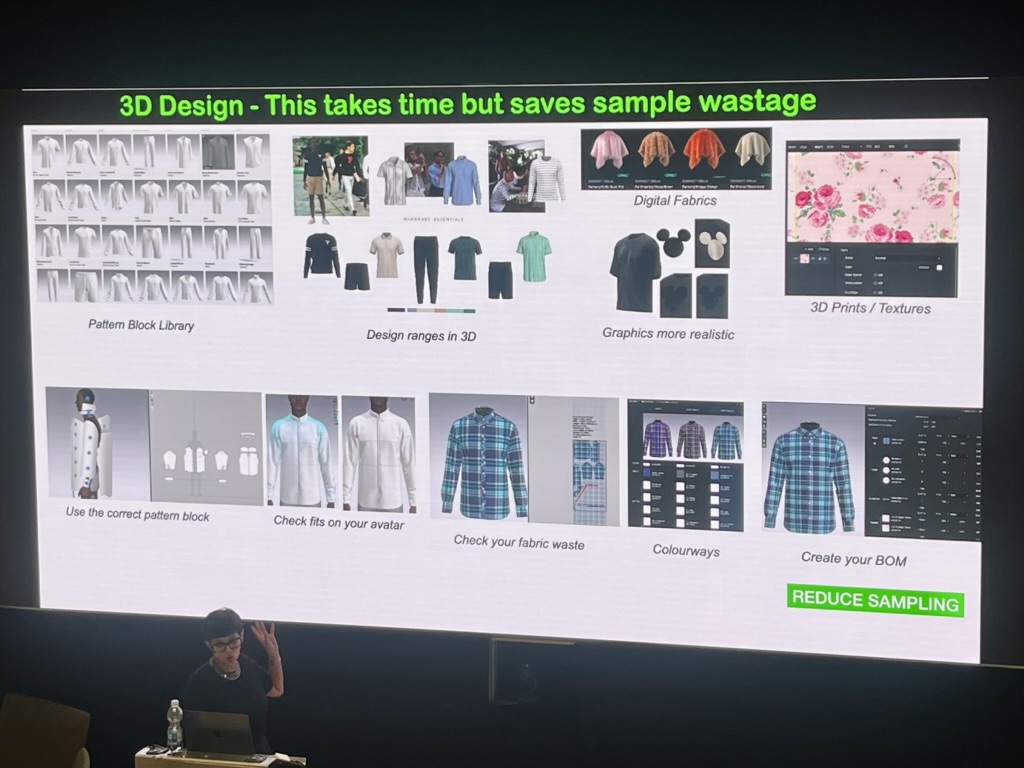
Maggie Mattioni, Freelance Designer and 3D expert, traced the journey from pre-3D to post-3D workflows, revealing how digital tools like virtual sampling and avatar fitting have revolutionised design efficiency and dramatically reduced waste. Brands including H&M now embrace 3D as a norm, leveraging AI-powered “sketch-to-image” technology to streamline creativity and production. H&M have enlisted models and created their 3D “twins”, enabling them to use these avatars without the expense of photoshoots, with the models themselves retaining the rights to their image, and earning royalties on their use. https://www.maggiemattioni.com/
AI as the Creative Co-Pilot
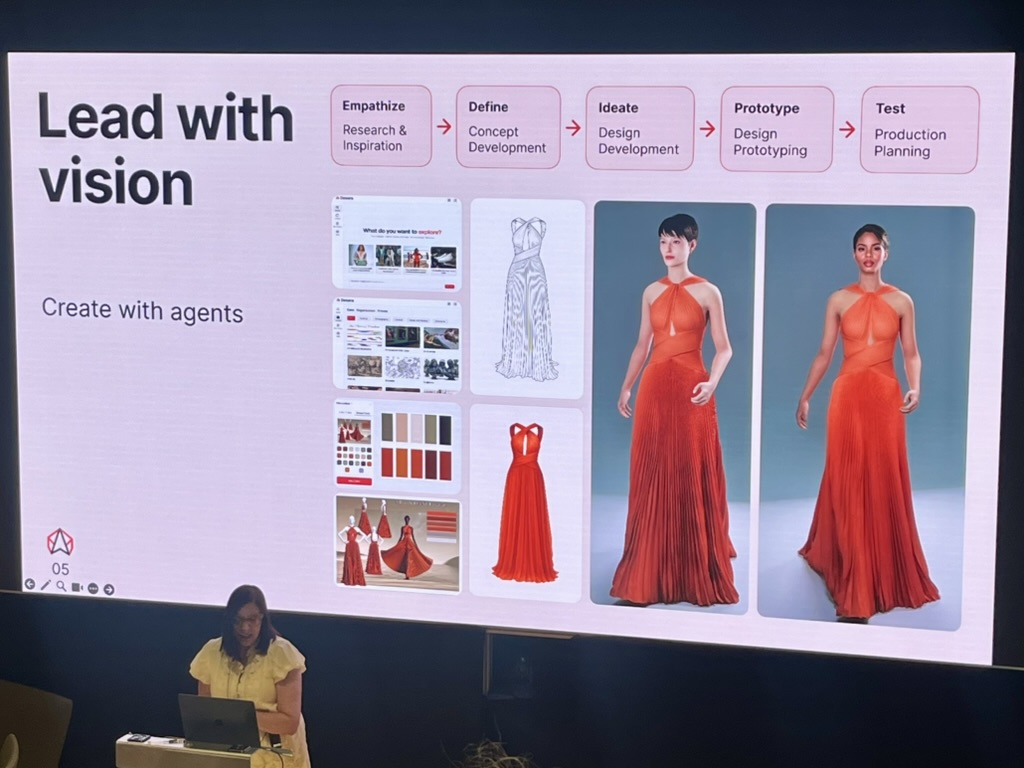
Suna Hasan, Creative Director at Desara.AI captivated attendees with a vision of AI as a creative collaborator – from early concept ideation through to photoshoots. By integrating disconnected design tools into a seamless, real-time workflow, Desara reduces creative waste and injects joy back into the process, enabling designers to co-create with AI rather than be replaced by it. https://www.desara.ai/
Dr Kausav Sengupta of Visionxt introduced the concept of cultural and emotional “colour maps” driven by live datasets, pushing AI beyond trend forecasting into the realm of human sentiment and cultural nuance. https://www.visionxt.in/
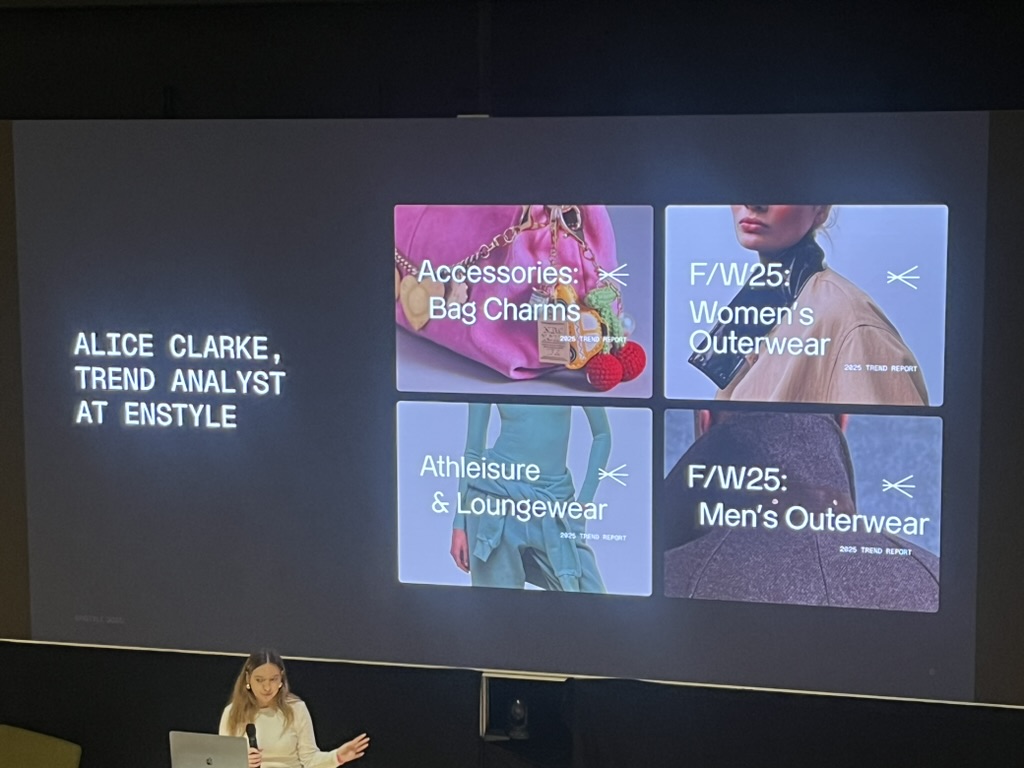
Alice Clarke, Trend Analyst at Enstyle demonstrated how AI enriches trend validation and product development by marrying data with design, turning creative ideas into commercially viable opportunities whilst minimising guesswork. https://enstyle.ai/
Merchandising in the Age of AI
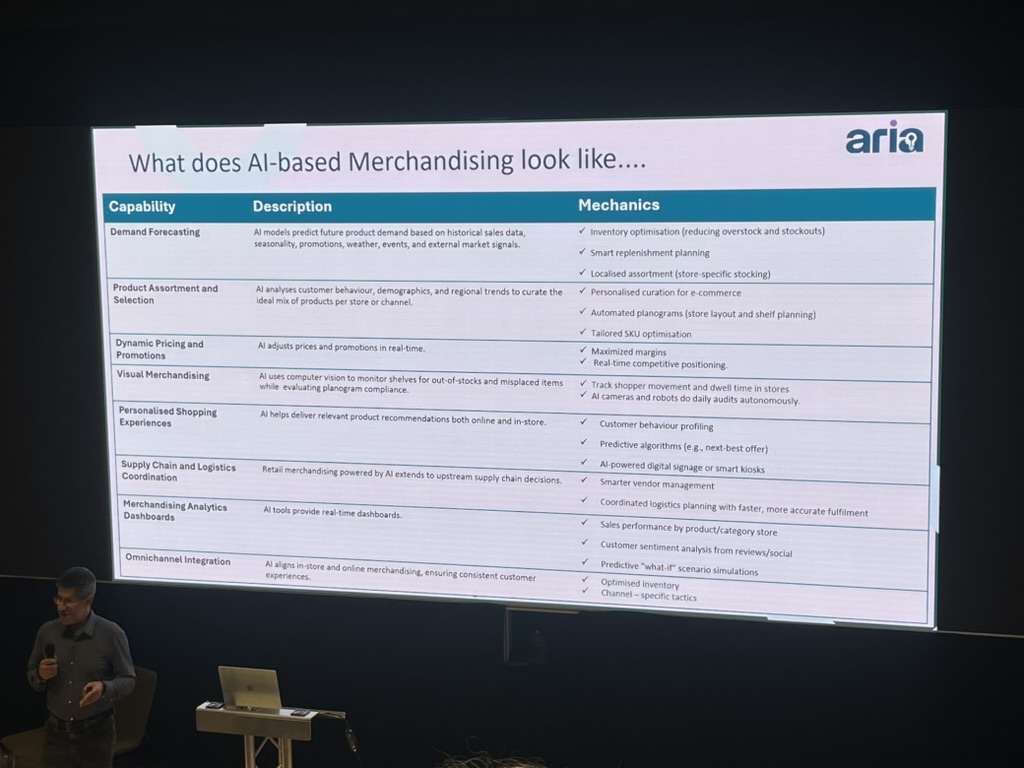
Aria’s transformative AI models promise to overhaul merchandising, turning what once took months into minutes. By combining generative AI and prompt engineering, merchandisers will gain unprecedented control over allocation, volume, and product enrichment – ushering in a customer-centric, data-driven future where AI works hand-in-hand with human expertise. https://ariaintelligentsolutions.com/
David Sheekey of Centric echoed this, describing how AI tools empower merchandisers to optimise in-season stock and forecast new product success with machine learning – reducing the stress of Monday morning trade meetings and empowering strategic decision-making. https://www.centricsoftware.com/en-gb/
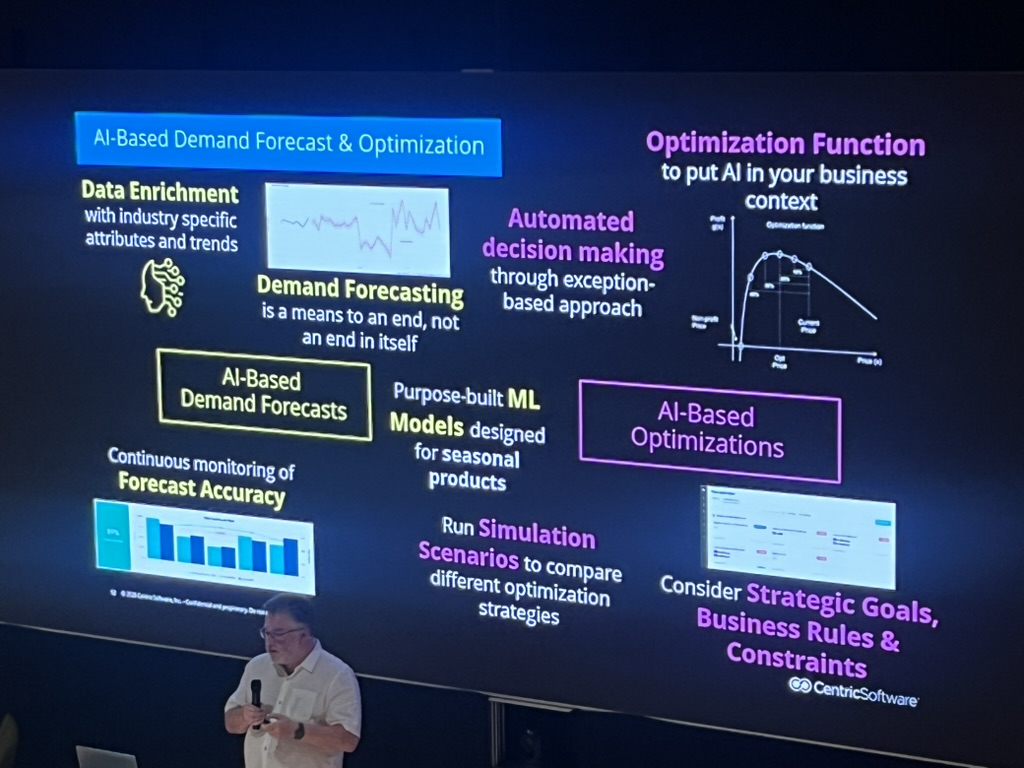
This really resonated with me – as a former fashion buyer myself, and having worked in a variety of retail businesses over many years, the Sunday night dread was something we lived with on a weekly basis. The right AI powered technology can alleviate much of the legwork, and provide suggested solutions, eliminating much of the stress associated with those dreaded trade meetings. Used in the right way, it can become that buyers “crystal ball” that we have all been looking for and joking about for years!
AI for Risk Management and Supply Chain Transparency
Katrina Duck and Michelle Morgan from Inspectorio identified the fact that we currently build systems for today’s reality, not adaptability for tomorrows risks (using the analogy of the Choluteca Bridge, the “bridge to nowhere” in Honduras, which became redundant when a hurricane caused the river to change course, rendering the bridge useless). They highlighted AI’s role in managing factory risks and real-time data insights, acting as a vigilant copilot that analyses compliance, quality, and corrective actions faster than traditional methods. https://www.inspectorio.com/

Andrew Xeni, founder of digital transformation business Fabacus and responsible fashion brand, Nobody’s Child, detailed how data systems integrating licensing, supplier compliance, and digital product passports (DPPs) are reshaping transparency and consumer trust, enabling brands to deliver sustainability with scale. https://fabacus.com/
Susan Young, Head of Transformation at John Lewis, took us through their AI journey to date, emphasising the point that ultimately it is about HUMANS and the way that they interact with AI technology that is important, enabling their partners to be more efficient. Susan identified some of the key lessons JLP has learnt along the way, including the fact that we should not expect AI to give us perfect answers, you need to work with it, empathise with it and it will learn and adapt to deliver what is needed. Susan identified the key skills employees will need for the future as being problem solving, storytelling and embracing curiosity.

Workforce Evolution and Ethical AI Use
Discussions stressed that AI is less about job displacement and more about role evolution. As AI automates routine tasks, new creative and analytical roles will emerge, requiring skills in prompt engineering, storytelling, critical and creative thinking.
Ethical AI use remains paramount: avoiding unconscious bias through advanced tagging and taxonomy was discussed, alongside the shared responsibility of educators and employers to prepare a workforce ready to harness AI’s power responsibly.
The Future is Now: Driving Innovation at LCF
Matthew Drinkwater, Head of the Fashion Innovation Agency at LCF, wrapped up the day by showcasing cutting-edge projects blending AI with fashion – from digital reskinning to highly sophisticated virtual try-ons, demonstrating how technology is not just a future promise but a present reality. The AI enhanced capability Matthew showcased was mind blowing!
The symposium ended on a rallying call:
“Don’t be an AI passenger, be the driver.”
With AI tools accelerating innovation, sustainability, and business efficiency, fashion professionals and students alike must embrace continuous learning to claim their place in this transformative era.
The London College of Fashion’s AI Symposium made one thing crystal clear: the future of fashion lies at the intersection of human creativity and artificial intelligence—an exciting, dynamic partnership poised to redefine the industry for generations to come.

 A Buyer's Life